Menu
This checklist serves as a guide for authors to ensure that manuscripts submitted to Pedagogy Review has complied the preliminary requirements prior to submission. By carefully reviewing each item, authors can streamline the evaluation process and demonstrate readiness for peer review and publication.
Publication Readiness. Before submission, authors should verify that references and citations are complete, accurate, and formatted according to APA 7th Ed. Style Guide. The manuscript must fall within the scope of Pedagogy Review and demonstrate relevance to its readership. Authors should also confirm readiness to comply with open access agreements and article processing charge (APC) policies to facilitate smooth progression to publication.
The peer review process commences with the submission of the manuscript through the journal’s online portal. Upon receipt, the Operations Officer retrieves the manuscript and its accompanying data to ensure compliance with all pre-requirements outlined in the submission checklist. Once verified, the manuscript is assigned a unique study code at the publication level. This code serves as the official identifier of the manuscript throughout the workflow. This study code is also integrated in the published version as a suffix to the generated Digital Object Identifier (DOI), thereby ensuring precise traceability and consistency across the journal’s records. Following this administrative phase, the manuscript is formally endorsed for preliminary evaluation, marking the transition from submission to scholarly review.
The scholarly review begins with the preliminary evaluation phase, which typically lasts about 7 days from submission to first decision. During this stage, the Executive Editor and Editor-in-Chief determine whether the manuscript aligns with the journal’s thematic scope and whether its methodology and argumentation demonstrate soundness. If either of these requirements is not met, the paper is rejected at this stage. This early decision-making ensures that only manuscripts with potential scholarly value proceed to full peer review, thereby saving time for both authors and reviewers.
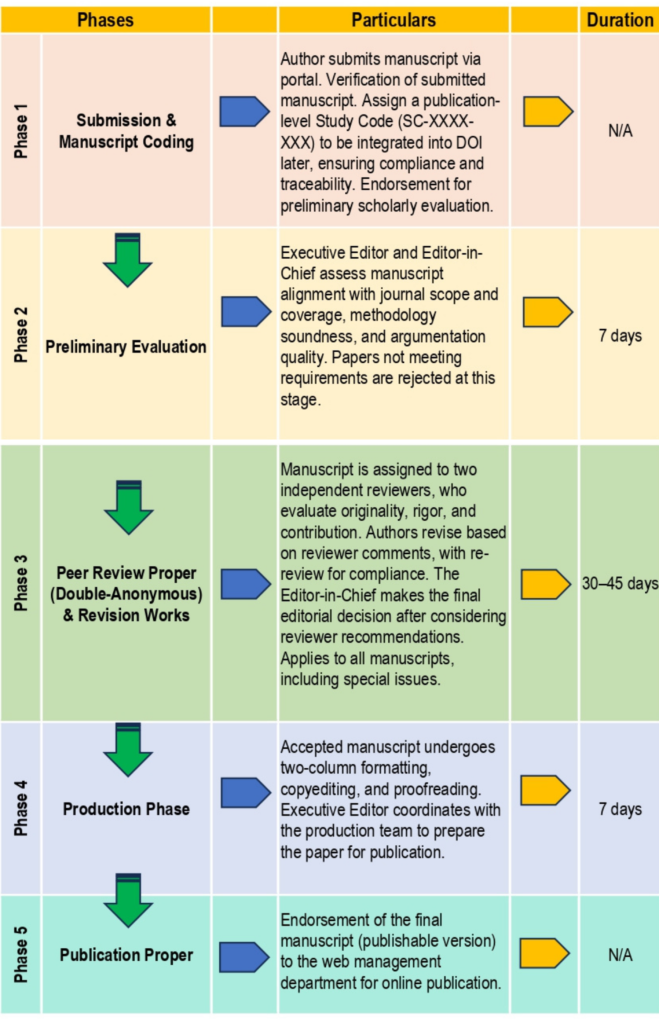
For manuscripts that pass the initial screening, the process moves into double-anonymous peer review proper, which spans approximately 30 to 45 days from submission to acceptance. At this stage, the Executive Editor, in coordination with the Editor-in-Chief, assigns the manuscript to two independent qualified Reviewers, who critically evaluate its originality, methodological rigor, and contribution to the field. These reviewers conduct the peer evaluation separately from the editorial team. Reviewers provide detailed comments and constructive suggestions, which are then communicated to the authors. Authors are expected to revise their manuscripts in response to these comments, applying the necessary rigor to strengthen their work. Revised manuscripts will undergo re-review to ensure that the revisions adequately address the reviewers’ concerns. The Editor-in-Chief makes the final editorial decision (acceptance or rejection) only after considering the recommendations of the independent reviewers and the quality of the authors’ revisions.
This independent peer review procedure applies to all manuscripts, including those submitted for special issues, ensuring consistency and transparency across the journal.
Once a manuscript is accepted, it enters the production phase, which typically lasts about 7 days. During this period, the paper undergoes two-column formatting, copyediting, and final proofreading. The Executive Editor coordinates closely with the production team to ensure that the manuscript is polished and ready for publication. After these final checks, the paper is lined up for publication.
This peer review process is deliberately exhaustive, combining administrative precision, scholarly evaluation, and rigorous revision. By applying the double-anonymous procedure, and involving the Executive Editor, Editor-in-Chief, and Reviewers in clearly defined roles, Pedagogy Review ensures that every manuscript is subjected to fair, thorough, and unbiased scrutiny. The journal maintains this high standard of review to safeguard its credibility and uphold the integrity of the scholarly record.
Learn more about publication ethics.
What is the importance of DOI?
APCs also ensure your article is permanently hosted on VMC Analytiks’ open access platform – the Digital Journal Philippines website, securely archived at Internet Archive, and widely disseminated through indexing and post-publication promotion through congratulatory poster in our FB page to maximize visibility and impact.
In addition, VMC Analytiks, the publisher of Pedagogy Review, extends gratitude through free Publication Vouchers distributed during research-related events such as conferences, symposia, and anniversaries, further strengthening its bond with the academic community.
Want to explore more about APCs?
The process is rigorous, requiring extensive editing to condense lengthy chapters into focused sections while reducing redundancy. Particular attention is given to trimming the manuscript’s length to comply with Pedagogy Review’s policy of a maximum 8,000 words. This reduction is not merely mechanical; it involves thoughtful rewriting to preserve the integrity of the research while enhancing readability and impact. By applying international formatting standards and enforcing strict word limits, the service ensures that the final article is concise, professional, and ready for submission to indexing databases and peer review.
Form: Code 4 – Request for Editing
The service is performed by Technical Experts from the Partner Editing Group (PEG) who are specialists in their respective fields. Their subject expertise allows them to edit manuscripts with precision, aligning revisions with disciplinary expectations and ensuring that the content remains accurate, relevant, and scholarly. Editors carefully restructure arguments, enhance clarity, and strengthen the overall presentation of the research, while maintaining fidelity to the author’s original work.
Because content editing requires extensive rigor, a minimum window of two weeks is allotted to complete the revision process. This timeframe allows editors to thoroughly analyze reviewer comments, apply necessary changes, and polish the manuscript to meet publication standards. The treatment of revision requirements is highly individualized, as each manuscript presents unique challenges depending on the scope and depth of reviewer feedback.
The fee for content editing ranges between 100 to 300 US dollars, reflecting the complexity of the revisions required. Final pricing is determined after a careful assessment of both the manuscript and the reviewer’s comments by the assigned editor. Authors who wish to avail this service must complete the corresponding request form below.
Form: Code 4 – Request for Editing
Explore the importance of IMRAD.
Before submitting, read the: